
Advanced Electrical Safety Premium Cables for Indian Homes - Innolex

Introduction to the Paradigm Shift in Residential Electrification
The core structure of residential living in the Indian subcontinent has experienced a significant transformation over the last twenty years. In modern homes today, electricity powers everything — from high-capacity air conditioners and heavy-duty refrigerators to advanced smart TVs, automated modular kitchens, and integrated home automation systems. With rising disposable incomes and an increasing desire for electronic convenience, the baseline electrical load needed to support a modern urban or semi-urban household has grown substantially. However, this increase in energy consumption also leads to a rise in systemic risk. As electrical loads increase, using low-quality wiring can become extremely hazardous, acting as the main trigger for devastating residential fires.
In the past, domestic wiring was considered a passive, hidden necessity, leading to cost-cutting measures and the use of substandard materials. Modern electrical engineering requires a complete reversal of this approach.
Choosing the best house wiring cable in India is not just about performance it’s about protecting your family, home, and appliances from potentially lethal electrical hazards. A building's electrical system is the active, continuous lifeline of the structure, and its safety relies entirely on the metallurgical purity of its conductors and the thermal stability of its insulating polymers.
To mitigate these escalating modern risks, organizations like Innolex Wires & Cables have pivoted their manufacturing paradigms. At Innolex Wires & Cables, we provide premium electrical wires engineered specifically for safety, unparalleled durability, and long-lasting performance under extreme thermal and environmental stressors.

1.1 Why Electrical Safety Matters in Indian Homes
The empirical data surrounding urban disasters highlights a grim reality: electrical short circuits and localized overheating are among the absolute leading causes of residential fires in India. The vast majority of these devastating accidents happen because of a combination of the following systemic failures :
Poor-quality wiring: The utilization of adulterated conductive materials or inferior insulation that degrades rapidly under thermal load.
Overloaded circuits: The connection of multiple high-amperage appliances to singular nodes designed for minimal current.
Old electrical systems: Legacy infrastructure possessing degraded dielectric strength, fundamentally incapable of supporting modern home automation or HVAC demands.
Non-certified cables: The influx of counterfeit or unverified products lacking the essential metallurgical and chemical testing mandated by the Bureau of Indian Standards (BIS).
Improper installation: Failures in foundational circuit design, inadequate termination, and the absence of requisite earthing protocols.
The systemic integration of ISI certified electrical wires and high-quality, high-purity copper cables significantly reduces these risks, establishing a robust defense against thermal runaway and dielectric breakdown.
2. Epidemiological Analysis of Electrical Hazards in India
To truly comprehend the imperative for advanced cable engineering, one must analyze the statistical landscape of electrical fatalities and residential fires across India. The National Crime Records Bureau (NCRB) and Accidental Deaths and Suicides in India (ADSI) reports offer a stark quantification of this crisis.
2.1 The Ascendancy of Residential Fires
Between 2020 and 2025, India recorded over 90,000 localized fire incidents in urban agglomerations, resulting in the tragic loss of over 15,000 lives and causing severe injuries to hundreds of thousands more. Crucially, an estimated 70% of these fatalities did not originate in massive industrial catastrophes or highly publicized commercial infernos, but rather from everyday, preventable anomalies within the home—specifically short circuits, kitchen fires, and careless electrical negligence.
The longitudinal data specifically tracking residential fires highlights the disproportionate danger posed by electrical faults:
Reporting Year | Estimated Total Residential Fire Incidents | Attributed Fatalities | Percentage Originating Directly from Electrical Faults |
2021 | 25,700 | 3,010 | 45% |
2022 | 27,100 | 3,300 | 47% |
2023 | 29,800 | 3,520 | 40% |
2024 | 31,000 | 3,740 | 43% |
2025 (Jan - Aug) | 19,400 | 2,220 | 44% |
Data synthesized from NCRB, NDMA, and State Fire Services Annual Data projections.
The statistics reveal that domestic electrical architectures are the most vulnerable nodes in urban infrastructure. In 2024, the Union Territory of Jammu and Kashmir reported an alarming statistic wherein 88.9% of all fire-related deaths occurred within residential or dwelling buildings, a crisis exacerbated by heavy winter heating loads placed upon aging or inadequate wiring systems. Furthermore, demographic analysis indicates that roughly 80% of fatal residential fires initiate during nighttime hours (10:00 PM to 6:00 AM), a window where occupants are asleep, reaction times are severely delayed, and the emission of toxic smoke from burning PVC insulation proves rapidly lethal before flames ever reach the victims.
3. Choose the Best House Wiring Cable
The structural integrity of a residential dwelling is paramount, but your home’s electrical system is only as safe as the wire inside your walls. The selection of the primary conductive pathways requires stringent adherence to metallurgical and polymer chemistry standards. When evaluating cables for modern infrastructure, professional electrical contractors and discerning homeowners must always select :
100% copper conductors: Ensuring the highest possible electron mobility and the prevention of localized junction heating.
Heat-resistant insulation: Polymers chemically engineered to withstand operational temperatures without softening, degrading, or losing their dielectric properties.
Fire-retardant protection: The inclusion of specialized chemical additives that actively extinguish flames and prevent the propagation of fire along the cable run.
High conductivity cables: Cables refined to eliminate impurities, thereby minimizing resistance and associated energy losses.
Deploying the best copper wire for home wiring provides transformative benefits that extend far beyond mere illumination. Foremost, it delivers better power efficiency, ensuring that the electrical energy paid for at the meter is effectively delivered to the appliance rather than dissipated as waste heat within the walls. Furthermore, superior conductors result in a significantly reduced voltage drop across long residential runs. A minimized voltage drop prevents sensitive electronics and heavy induction motors (such as HVAC compressors) from operating under high-strain, low-voltage conditions, which is a primary cause of premature appliance failure.
Consequently, high-quality copper equates to a lower overheating risk and a far longer lifespan for both the electrical infrastructure and the appliances connected to it. Recognizing these critical engineering mandates, Innolex Wires & Cables offers highly trusted, heavily tested house wiring solutions that are explicitly designed for the rigorous demands of modern Indian homes.
4. Why Copper Wiring is Better (Conductor Metallurgy)
The foundational element of any electrical system is the metallic core responsible for electron transport. While aluminum presents a cheaper alternative often utilized in external utility distribution, copper remains the unequivocally preferred material for safe, efficient, and durable domestic electrical systems.
4.1 The Physics of Conductivity and Resistance
Copper possesses an atomic structure that offers minimal resistance to the flow of electrical current. According to the International Annealed Copper Standard (IACS), electrolytic grade copper achieves a conductivity rating of 100% or greater. This superior conductivity is vital when considering the physics of Joule heating, governed by the equation $P = I^2R$ (where Power dissipated as heat equals the square of the Current multiplied by Resistance).
When inferior metals or heavily adulterated copper are utilized, the intrinsic resistance ($R$) of the wire increases. As high-wattage modern appliances draw significant current ($I$), the resulting heat generation ($P$) within the walls multiplies exponentially. This chronic thermal stress continuously degrades the surrounding polymer insulation, eventually leading to a complete breakdown of the dielectric barrier and initiating a short circuit.
4.2 Mechanical Superiority: Flexibility and Maintenance
Beyond pure conductivity, the benefits of copper include its superior mechanical properties. Copper boasts significantly higher conductivity per cross-sectional area, allowing for thinner, more manageable cables without compromising load capacity. Furthermore, through the process of bright annealing, multi-stranded copper wires achieve better flexibility. This flexibility is critical for pulling cables through the complex, heavily angled conduit networks of modern housing developments without snapping individual strands—a phenomenon that reduces the effective cross-sectional area and creates dangerous "hot spots."
Copper also naturally resists the rapid, debilitating oxidation that plagues aluminum wiring, thereby requiring far lower maintenance over a multi-decade lifespan. Finally, copper's superior thermal conductivity contributes to improved heat resistance, allowing the wire to rapidly dissipate any minor thermal loads into the surrounding environment before they threaten the insulation. As a premier and trusted copper cable supplier India, Innolex Wires & Cables insists on utilizing only 99.97% pure electrolytic grade bare copper, consistently delivering high-performance copper wiring solutions for both residential and commercial use.
5. Use Fire Resistant Electrical Wires (Polymer Insulation Dynamics)
While the copper core dictates electrical efficiency, the surrounding polymer insulation dictates the wire's behavior during a catastrophic thermal event. Historically, domestic cables were insulated with standard Polyvinyl Chloride (PVC). However, standard PVC is highly combustible and acts as a fuel source that rapidly spreads fire from room to room through concealed wall conduits.
Consequently, one of the smartest, most effective investments for comprehensive home safety is installing fire resistant electrical wire. Through advanced polymer chemistry, manufacturers introduce specialized flame-retardant additives into the PVC matrix. These wires are specially designed to execute specific defensive functions during a fire :
Resist high temperatures: Advanced FR wires boast a Temperature Index (TI) exceeding 250°C, meaning they maintain structural and dielectric integrity at temperatures that would easily melt standard PVC.
Slow down flame spread: FR cables possess a high Oxygen Index (OI)—typically above 29%. Because atmospheric air contains only about 21% oxygen, these cables cannot sustain combustion under normal atmospheric conditions. They are self-extinguishing; once the external source of the fire is removed or exhausted, the wire ceases to burn.
Reduce fire damage: By compartmentalizing the fire and preventing it from utilizing the electrical conduit as a travel vector, FR cables isolate the damage to the point of origin.
Improve electrical safety: Maintaining insulation integrity for as long as possible prevents secondary short circuits that could complicate firefighting efforts.
To ensure survival and structural protection, modern homes should always use FR wires, FRLS wires, or heat-resistant copper cables rather than standard commercial wiring. Demonstrating a commitment to evolving safety standards, as a rapidly growing FR wire manufacturer India, Innolex Wires & Cables focuses intensely on advanced, safety-focused cable technology, ensuring every residential product exceeds baseline flame retardancy metrics.
6. Install FRLS Cables for Extra Protection (The Threat of Toxic Smoke)
While standard FR (Flame Retardant) wires are highly effective at restricting the spread of flames, they possess a severe vulnerability: when subjected to immense external heat, the halogenated compounds (like chlorine) within the PVC breakdown, producing dense, opaque black smoke and highly toxic, corrosive Hydrogen Chloride (HCl) gas. In the context of a residential fire, toxic smoke inhalation is responsible for over 80% of fatalities, often incapacitating victims before they are directly exposed to flames.
Therefore, for densely populated spaces such as apartments, offices, schools, and commercial spaces, adhering to FRLS cable manufacturer standards is extremely important. Flame Retardant Low Smoke (FRLS) and Flame Retardant Low Smoke Halogen (FRLSH) cables represent a leap forward in life-safety engineering. FRLS cables provide :
Fire resistance: Maintaining the self-extinguishing and high-temperature tolerance of standard FR cables.
Low smoke emission: Specially formulated to minimize particulate release. In the event of a fire, FRLS cables guarantee a minimum visibility of 40%, whereas standard FR cables rapidly reduce visibility to near zero. This visibility is the critical factor allowing occupants to locate emergency exits.
Reduced toxic gas release: FRLS compounds significantly restrict the emission of lethal halogen gases, preventing rapid asphyxiation and lung damage.
Better evacuation safety during emergencies: By maintaining breathable air and clear lines of sight, these cables transform a chaotic, deadly scenario into a manageable evacuation.
Due to these life-saving characteristics, these advanced cables are ideal for, and often legally mandated in, residential buildings, hospitals, commercial projects, and high-rise apartments.

7. Climatological Stressors and Proper Earthing
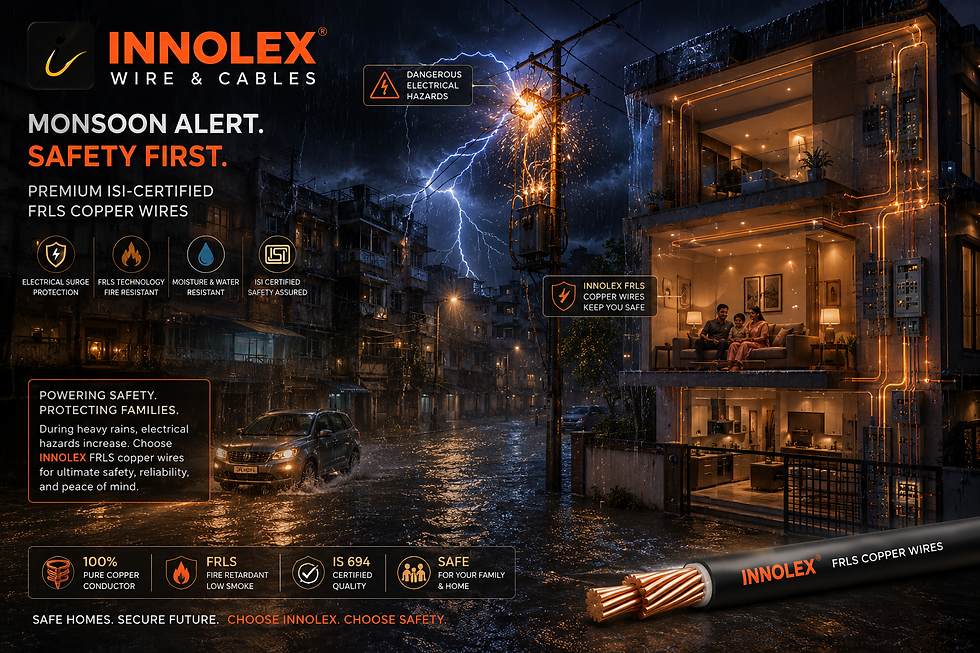
The Indian subcontinent is characterized by extreme environmental shifts, most notably the intense monsoon season. The combination of torrential rain, high humidity, and atmospheric electrical storms places immense stress on domestic electrical grids.
7.1 Moisture Ingress and Dielectric Degradation
During the monsoon, atmospheric moisture permeates structures. Water is inherently conductive, and when it infiltrates aging or compromised insulation, it creates unintended electrical pathways. This leads to persistent leakage currents that can electrify damp walls, switchboards, and the metallic chassis of home appliances. If a resident interacts with these compromised surfaces with wet hands, the result can be a lethal electrocution.
Furthermore, monsoon lightning strikes induce massive transient overvoltages (surges) across the local power distribution network. When these surges enter a home lacking proper protective infrastructure, they can instantaneously shatter receptacles, obliterate sensitive electronics, and ignite structural fires.
7.2 The Imperative of Proper Earthing
To counteract both moisture-induced leakage and transient surges, proper earthing is absolutely essential. Earthing, or grounding, provides a dedicated, ultra-low resistance pathway for errant electrical currents to dissipate safely into the earth, entirely bypassing the human body. Proper earthing protects homes from :
Electric shocks: Diverting fault currents away from human contact.
Voltage fluctuations: Stabilizing the electrical phase and managing lightning-induced transients.
Appliance damage: Preventing the chassis of washing machines, refrigerators, and microwaves from becoming dangerously electrified.
The National Building Code (NBC) 2016 and IS 3043 strictly mandate that residential earthing systems maintain a resistance of ≤ 5 Ohms. Good grounding, when seamlessly combined with advanced electrical safety wiring solutions and active protection devices like Residual Current Circuit Breakers (RCCBs), helps maintain a definitively safer electrical environment, neutralizing the threats posed by both structural faults and severe weather.
8. Avoid Overloading Electrical Circuits
While utilizing premium cabling establishes a safe baseline, the operational habits of the residents ultimately dictate the long-term safety of the system. The mathematical reality of modern consumption is that overloaded sockets are one of the biggest causes of short circuits in Indian homes.
Every electrical outlet and the specific wire gauge feeding it is rated for a maximum safe amperage. When residents utilize multi-plug adapters ("stud boards" or "daisy chains") to connect numerous devices, they force the circuit to carry a load far beyond its designed thermal capacity. As the current exceeds the rating, the copper conductors heat exponentially ($P=I^2R$). This heat melts the PVC insulation from the inside out, leading directly to arcing and combustion.
To maintain absolute safety, residents must stringently avoid connecting :
ACs
Heaters
Microwaves
Irons
Washing machines
...to a single outlet or extension cord. These heavy-draw, induction, or resistive heating appliances require dedicated, heavy-gauge circuits routed directly back to the primary distribution board. Using the safest wire for house wiring along with proper, forward-looking circuit planning helps prevent overheating and catastrophic power failures.
9. Replace Old or Damaged Wiring
The electrical infrastructure of a building is not permanent; it degrades over time. Insulation polymers become brittle, harden, and crack due to decades of thermal cycling and environmental exposure. Old wiring systems often cannot handle today’s electrical load, as they were installed during an era before the proliferation of continuous-draw appliances like heavy-duty air conditioners and modern induction cooktops.
Operating a modern smart home on a legacy electrical grid is a profound hazard. Residents must remain vigilant for the warning signs that the internal wiring has reached the end of its safe operational lifespan. Critical warning signs include :
Flickering lights: Indicating loose connections or severe voltage drops due to failing conductor integrity.
Burning smell: The distinct, acrid odor of melting PVC insulation, signifying immediate thermal danger behind the walls.
Warm switchboards: Switchplates that are hot to the touch indicate localized high-resistance joints and impending failure.
Frequent tripping: Miniature Circuit Breakers (MCBs) repeatedly tripping is the system’s desperate attempt to prevent an overload fire.
Sparking sockets: Visible arcing when a plug is inserted or removed.
Ignoring these symptoms is a gamble with catastrophic consequences. Upgrading older properties to modern, high-purity heat resistant electrical cable improves both safety and overall energy efficiency, eliminating the hazardous energy waste caused by deteriorated legacy wiring.
10. Choose ISI Certified Electrical Wires
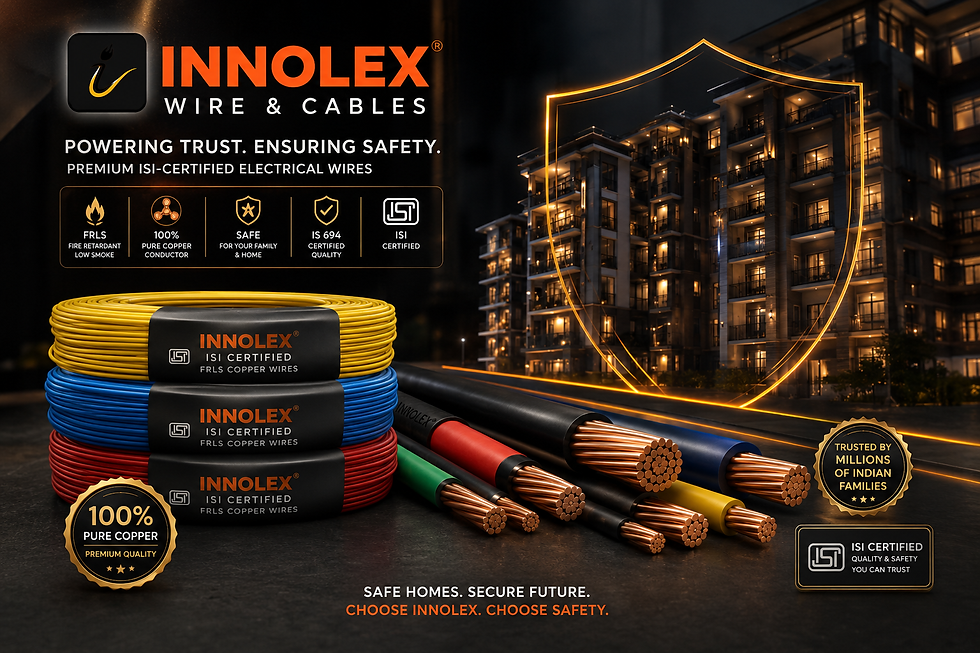
The Indian electrical market contains a vast array of counterfeit, non-standard, and highly dangerous unbranded cables. These products utilize adulterated scrap copper, undersized conductor diameters to save costs, and cheap plastics that possess zero fire-retardant capabilities. In a life-safety application, you must never compromise on electrical quality.
The Bureau of Indian Standards (BIS) enforces rigorous testing protocols designed to protect the consumer. Specifically, IS 694:2010 outlines the mandatory requirements for PVC insulated cables up to 1100 Volts. To guarantee safety, consumers and contractors must always verify :
ISI certification: The presence of the authentic ISI mark on the cable jacket, alongside the governing standard code (e.g., IS 694:2010).
Copper purity: Ensuring the core is Class 5 annealed, high-conductivity electrolytic copper.
Insulation quality: Verifying compliance with thermal aging, hot deformation, and shrinkage tests.
Fire resistance: Ensuring the cable passes stringent vertical flammability and oxygen index protocols.
Furthermore, authentic cables will feature the manufacturer's unique CM/L (license number) printed directly on the wire, allowing for complete traceability. Reliable, elite-tier electrical wire manufacturer India brands strictly follow these safety standards—and often exceed them—to ensure absolute long-term performance and structural safety.
11. Use Industrial Grade Quality for Better Durability
The line dividing commercial industrial power consumption and modern residential power consumption is blurring rapidly. With the advent of multi-zone central air conditioning, domestic electric vehicle (EV) charging stations, and extensive home automation servers, today’s homes consume more electricity than ever before.
Standard, budget-grade residential wires are increasingly incapable of managing this relentless, high-amperage baseline. That’s why many forward-thinking architects and homeowners now prefer to integrate industrial-level technology into domestic environments. They specifically demand:
Industrial-grade insulation: Polymers formulated to resist not just heat and fire, but also chemical exposure, dampness, and rodent or termite attacks.
Heavy-duty copper conductors: Utilizing larger cross-sectional areas (e.g., 4.0 sq.mm to 6.0 sq.mm) capable of sustained high-current delivery without exhibiting measurable thermal rise.
Advanced safety protection: Features such as triple-layer insulation for exceptional mechanical toughness during installation.
By applying industrial manufacturing tolerances to residential products, premium industrial electrical cables provide :
Better load handling: Managing sudden transient spikes from motor start-ups without degrading.
Longer lifespan: Resisting the slow degradation caused by thermal cycling.
Higher durability: Surviving the physical trauma of being pulled through tight, complex pathways.

12. Invest in Safe Electrical Infrastructure
As the Indian residential landscape accelerates toward smart, automated, and highly electrified living, the foundational electrical grid must evolve correspondingly. Modern homes require reliable and, crucially, future-ready electrical systems. Cutting costs on the conductive infrastructure that powers an entire structure is a false economy that inevitably results in devastating physical and financial losses.
Choosing a trusted, highly certified power cable manufacturer India like Innolex Wires & Cables directly ensures :
Better electrical performance: Uninterrupted, efficient power delivery free from crippling voltage drops.
Reduced fire hazards: The absolute minimization of thermal runaway and the containment of potential flames through advanced polymer chemistry.
Improved appliance safety: Protecting high-value smart electronics and heavy white goods from the ravages of poor power quality and surge events.
Long-term reliability: Installing a system designed to operate flawlessly for decades, requiring zero internal maintenance.
Ultimately, consumers, contractors, and builders must embrace a fundamental shift in philosophy: Safe wiring is not an expense — it’s an investment in your family’s absolute protection and the enduring security of your home.


Comments